
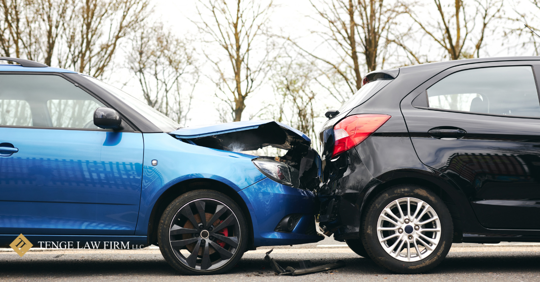
The seconds after a rear-end crash can feel almost dreamlike. You were stopped, or nearly stopped, and then your seat lurched forward and your neck snapped back. Now you’re on the shoulder with a sore neck, an insurance card in your hand, and a reasonable assumption: the driver who hit you is clearly at fault. Colorado law even supports that assumption. But the other driver’s insurer doesn’t see it that way, and disputes over rear-end collisions in Colorado are more common than most people expect.
Since 1992, Tenge Law Firm LLC has represented accident victims across Colorado, and we’ve seen how quickly an insurer can shift the conversation from “who caused the crash” to “what did you do to contribute to it.” The presumption of fault that Colorado law places on the rear driver is real, but it’s also rebuttable. The evidence you gather in the hours, days, and weeks after a crash is what determines whether that presumption holds.
Why Colorado’s Rear-End Presumption Doesn’t Settle Fault by Itself
Colorado Revised Statute 42-4-1008 requires every driver to maintain a following distance that’s reasonable and prudent given road conditions, speed, and traffic. When a rear-end collision occurs, that statute forms the basis for a presumption of negligence against the rear driver, a principle codified in Colorado Jury Instruction 11:12. The word “rebuttable” is the key: the presumption exists unless the other side produces evidence to overcome it. Insurers routinely try. Common arguments include that the front driver made a sudden, unexpected lane change, had non-functioning brake lights, or stopped without warning. None of these automatically succeed, but all of them create a dispute that evidence needs to resolve.
Colorado’s modified comparative negligence rule, found in C.R.S. 13-21-111, sets the stakes. A driver found 50% or more responsible for the crash recovers nothing. Any share of fault below that threshold reduces the final recovery by that percentage. So if a jury finds you 20% responsible, your damages are reduced by 20%. That’s why the evidence you collect isn’t just about proving the other driver was negligent; it’s about keeping your own share of fault as low as the facts support.
Scene Evidence That Locks In the Facts
The crash scene exists for a short window. Once vehicles are moved, traffic resumes, and weather changes the road, physical evidence disappears. Capturing it quickly gives your case a factual foundation that can’t be disputed later.
- Vehicle damage and positioning: Photograph the damage pattern, the point of impact, and the resting position of both vehicles before they’re moved. Bumper height and the shape of the crush zone can help an accident reconstruction analyst establish the angle and force of the collision.
- Road and weather conditions: Photograph skid marks, road surface, traffic signals, and any debris. These details tell a story about whether the rear driver had adequate stopping distance and whether conditions played any role.
- Independent witnesses: Names and phone numbers from bystanders who saw the crash can be decisive when the two drivers describe events differently. Witnesses have no stake in the outcome, and their accounts carry weight with adjusters and juries alike.
Getting the Boulder Police Report and Knowing Its Limits
If Boulder Police responded to the crash, an official report was generated documenting the responding officer’s observations, any citations issued, and basic facts about the collision. The Boulder Police Department Records Unit is located at 1805 33rd Street, Boulder, CO 80301; requests can be submitted online, by mail, or in person through the department’s records portal. Fees apply depending on the records requested.
A police report reflects what the officer observed after arriving, not the crash itself. Any citation issued is relevant to a civil claim, but Colorado courts treat the report as one piece of evidence, not a binding determination of civil liability. It works best alongside photographs, witness accounts, and other documentation, not as a substitute for them.
The Evidence Most Guides Skip: Your Vehicle’s Event Data Recorder
Most vehicles manufactured in the last two decades contain an event data recorder (EDR), sometimes called a black box. In the seconds before a crash, an EDR captures pre-impact speed, throttle position, brake application, and sometimes seatbelt status. That data can confirm or directly contradict a driver’s account of what happened.
Under Colorado’s vehicle data recorder statutes, EDR data belongs to the vehicle owner and generally can’t be accessed without the owner’s consent, a court order, or a formal discovery request tied to a claim. The critical issue is preservation: EDR data is stored on a limited cycle and can be overwritten as the vehicle is driven after the crash. If the rear driver’s vehicle is repaired or returned to normal use, the pre-crash data may be gone. The sooner a preservation request or legal hold is issued, the better.
Building the Medical & Financial Case
Colorado insurers have a standard playbook for low-speed rear-end claims: argue that the crash couldn’t have caused the injury. Minimal vehicle damage, they say, means minimal force, which means the neck or back pain must come from something else. Medical evidence is what defeats this argument.
Early Medical Evaluation
A same-day or next-day evaluation creates a documented connection between the crash and your symptoms. Waiting several days gives the insurer a window to argue the injury was pre-existing or unrelated. Even if you feel only mildly sore at the scene, adrenaline can mask symptom severity in the immediate aftermath of a collision. Getting evaluated protects both your health and your claim.
Consistent Treatment Records
Consistent follow-up care, physician notes documenting your symptoms over time, and records that trace the progression of a soft tissue injury or whiplash connect the crash to your ongoing condition. A single ER visit followed by nothing creates gaps that adjusters will use against you. This continuity matters especially in cases where vehicle damage looks minor but the biomechanical forces involved were still significant enough to cause injury.
Economic Documentation
Lost income, out-of-pocket medical expenses, and other financial consequences of the injury need documentation to become part of a demand package. Pay stubs from before and after the crash, a letter from your employer confirming missed work, and receipts for prescription costs or medical equipment give the economic side of your claim the same concrete foundation that strong physical evidence gives the liability side.
Pulling It All Together
Colorado’s presumption of negligence in rear-end collisions gives injured drivers a meaningful legal advantage, but it doesn’t replace the need for evidence. An insurer that wants to dispute a claim will look for anything that shifts blame, reduces the injury’s apparent severity, or erodes the damages calculation. Scene photographs, witness information, the police report, EDR data, and thorough medical documentation each address a different part of that challenge. The pieces most people miss (EDR data and a prompt medical evaluation) often turn out to be the most decisive, and both disappear quickly if action isn’t taken early.
At Tenge Law Firm LLC, J. Todd Tenge and our team work directly on each case, which means we can move quickly on evidence preservation and investigation for Boulder clients. If you were rear-ended and want to understand what your case requires, call us at (303) 219-7377.